Eps 1: what is blockchain and smartcontract
In a 10-minute podcast titled "What is Blockchain and Smart Contracts," the speakers discuss the fundamental concepts and functionalities of blockchain technology and smart contracts. They start by explaining that blockchain is essentially a decentralized and transparent digital ledger where transactions or data are recorded in blocks and then chained together in a chronological order. This technology eliminates the need for intermediaries, making transactions more efficient and secure. Additionally, blockchain is immutable, meaning that once a block is added, it cannot be altered without consensus from the network. The podcast further delves into the concept of smart contracts, which are self-executing contracts with predefined rules encoded into the blockchain. These digital agreements automatically execute once the predetermined conditions are met. Their most significant advantage is their trustworthiness and self-enforcing nature, reducing the need for intermediaries and manual processing. The speakers emphasize that blockchain technology extends beyond cryptocurrencies and has the potential to revolutionize various industries such as supply chain management, healthcare, finance, and real estate. They highlight that blockchain's decentralized nature ensures transparency and enhances security, reducing fraudulent activities. Towards the end of the podcast, the speakers discuss potential challenges and limitations of blockchain technology, such as scaling issues, energy consumption, and legal considerations. Nonetheless, they remain optimistic about the future of this technology and its potential to shape various sectors through its efficiency, security, and automation provided by smart contracts.
| Seed data: | Link 1 |
|---|---|
| Host image: | StyleGAN neural net |
| Content creation: | GPT-3.5, |
Host

Corey Hopkins
Podcast Content
To understand blockchain, we must first comprehend its fundamental definition. In simple terms, a blockchain is a digital, decentralized ledger that records transactions across multiple computers or nodes. It eliminates the need for intermediaries, such as banks or third-party institutions, by relying on a distributed network of computers to validate and verify transactions. This peer-to-peer network ensures the security and transparency of the data stored on the blockchain.
The genesis of blockchain technology is attributed to the invention of Bitcoin, a digital currency created by an anonymous person or group of people known as Satoshi Nakamoto. Bitcoin was the first application of blockchain technology, intended to disrupt the traditional financial system and provide a decentralized alternative. Since then, blockchain has evolved to encompass various other applications beyond cryptocurrencies.
One crucial feature of blockchain is its immutability. Once a transaction is recorded on the blockchain, it cannot be altered or tampered with. This is achieved by utilizing cryptographic algorithms that ensure the integrity of the data on the network. This immutability establishes trust and eliminates the need for intermediaries to validate transactions. Instead, the blockchain itself acts as a trusted source of truth.
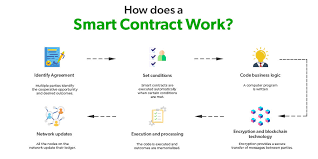
Now that we have a basic understanding of blockchain, let us explore the concept of smart contracts. Smart contracts are self-executing contracts with predefined rules and conditions embedded within the code. They automatically facilitate, verify, and enforce the performance of an agreement without the need for intermediaries. In other words, smart contracts are programmable agreements that execute on the blockchain.
Smart contracts are built on the blockchain's underlying technology, utilizing its decentralized and immutable nature to execute their intended functions. As the name suggests, smart contracts are "smart" in the sense that they are autonomous and can act according to predefined rules. They ensure transparency, security, and efficiency in various domains beyond finance, including supply chain management, healthcare, and real estate.
The potential impact of smart contracts is immense. By eliminating intermediaries and reducing the need for trust, smart contracts can revolutionize industries by increasing efficiency, reducing costs, and eliminating possibilities of fraud. Their execution is driven by a set of predefined conditions, ensuring that all parties involved adhere to the agreed-upon terms and preventing any unjust behavior.
However, it is important to acknowledge that while smart contracts have numerous advantages, they are not without limitations. One major challenge is the issue of security vulnerabilities. Smart contracts are written in code, and any bugs or loopholes within the code can be exploited by malicious actors. Such incidents have resulted in significant financial losses and raised concerns about the reliability of smart contracts.
Moreover, smart contracts are restricted by their ability to interact with external data sources. As they are confined to the blockchain ecosystem, obtaining data beyond the blockchain can be challenging. This limitation poses obstacles for applications that heavily rely on external data, such as insurance contracts or decentralized applications.
In conclusion, blockchain and smart contracts are interrelated concepts with enormous potential to transform various industries. Blockchain's decentralized and immutable nature provides the foundation for smart contracts to autonomously execute agreements without the need for intermediaries. While there are challenges to be addressed, the benefits of blockchain and smart contracts cannot be denied. As technology evolves, we can expect to witness the widespread integration and adoption of blockchain and smart contracts in our everyday lives.