Eps 29: Virgen Morena (en English)
— The Mexican Marian Apparition Podcast
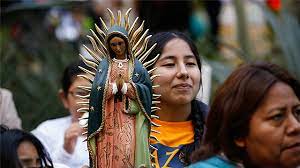
The podcast titled "Virgen Morena (en English)" discusses the history and significance of the Virgen Morena, also known as Our Lady of Guadalupe, in Mexican culture. The host starts by explaining the story of Juan Diego, an indigenous man who claimed to have witnessed the Virgin Mary appearing to him on Tepeyac Hill in 1531. The Virgin instructed Juan Diego to go to the bishop and request the construction of a church on the site. After facing doubts from the bishop, Juan Diego returned to the hill where the Virgin appeared again and instructed him to collect roses as a sign. When Juan Diego presented the roses to the bishop, his cloak revealed an image of the Virgin Mary, which is now known as the Virgen Morena. The podcast emphasizes the importance of the Virgen Morena in Mexican society and culture. This religious figure has become deeply ingrained in the Mexican identity and has a strong connection with indigenous communities. The host discusses the large number of pilgrims who visit the Basilica of Guadalupe in Mexico City each year to pay tribute to the Virgen Morena. Moreover, the Virgen Morena has been a symbol of unity and hope for Mexicans throughout history, particularly during times of struggle and oppression, such as the Mexican Revolution. The podcast also touches on the role of the Virgen Morena in the Chicano movement in the United States. The Virgen Morena iconography became a powerful symbol for Mexican-Americans seeking recognition and inclusion in American society. The host emphasizes that the devotion to the Virgen Morena is not exclusive to Mexico, but extends to Mexican communities around the world. In conclusion, the podcast provides a brief overview of the Virgen Morena's historical significance, her role in Mexican culture, and her influence on the Mexican-American community. The Virgen Morena holds a deep spiritual and cultural connection for Mexicans and serves as a symbol of hope, unity, and identity for many.
| Seed data: | Link 1 |
|---|---|
| Host image: | StyleGAN neural net |
| Content creation: | GPT-3.5, |
Host

Katherine Edwards
Podcast Content
Introduction:
Welcome to today's podcast episode, where we delve into the intriguing story of the Virgen Morena, a revered religious figure in Mexico. Known as the Dark Virgin, this is a fascinating tale that intertwines faith, history, and cultural significance. Join us as we explore the origins, miracles, and the enduring impact of the Virgen Morena.
Origin and Symbolism:
The story of the Virgen Morena dates back to the 16th century, during the Spanish colonization of Mexico. It is said that in 1531, the Virgin Mary appeared to an indigenous peasant named Juan Diego on the Hill of Tepeyac. As evidence of her presence, she imprinted her image on Juan Diego's cloak, known as a tilma, which was made of rough cactus fiber. The image revealed a mestiza Virgin, with dark skin, symbolizing her connection to the native population. This image became known as the Virgen Morena, or the Dark Virgin.
Miracles and Devotion:
The appearance of the Virgen Morena to Juan Diego sparked a series of miraculous events. The tilma was presented to the bishop, and as Juan Diego opened his cloak, a cascade of roses fell to the ground. But what astonished the crowd was the image of the Dark Virgin, imprinted on the rough fabric. This event led to the construction of a shrine on the hill of Tepeyac, where the tilma is still housed today.
Throughout the years, numerous miracles have been attributed to the Virgen Morena. From healings to conversions, her intercession is believed to have brought numerous favors to those who invoke her name. Millions of pilgrims flock to the Basilica of Guadalupe each year, where the tilma is on display, seeking spiritual solace and invoking her aid.
Cultural Significance:
The Virgen Morena holds immense cultural significance, not only in Mexico but throughout the Americas. Her image has become an emblem of Mexican identity, representing the fusion of indigenous and Spanish cultures. She is revered by both Catholics and indigenous communities, bridging two worlds and serving as a unifying figure. Her symbolism transcends religious boundaries, embracing a sense of national pride and cultural heritage.
The Feast Day:
Every year on December 12th, the Catholic Church celebrates the Feast of Our Lady of Guadalupe, honoring the Virgen Morena. This occasion is marked by vibrant processions, music, dance, and traditional foods. Notably, it is the most widely celebrated religious festival in Mexico, drawing both locals and international visitors. The festivities not only pay homage to the Virgen Morena but also demonstrate the fusion of faith and cultural tradition.
Enduring Legacy:
The Virgen Morena's legacy extends far beyond her origins. She became a symbol of hope, faith, and resilience for the Mexican people, especially during difficult times. Her image has inspired countless artists, musicians, and poets, becoming a muse of creative expression. Today, the Virgen Morena's presence is not limited to Mexico alone; her devotion has spread worldwide with the migration of Mexicans, who carry her image and devotion to various corners of the globe.
Conclusion:
In conclusion, the story of the Virgen Morena captures the essence of Mexico's rich religious and cultural heritage. From her miraculous appearance to her enduring legacy, this Dark Virgin continues to inspire millions of faithful believers worldwide. Whether through devotion, art, or celebration, the Virgen Morena remains an enduring symbol of hope, unity, and inner strength. Let us remember the timeless significance of her story and the profound impact she has had on the lives of so many.