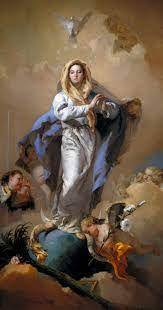
Eps 1: The Immaculate Conception
In a 10-minute podcast titled "The Immaculate Conception," the host discusses the religious concept of the Immaculate Conception. The Immaculate Conception refers to the belief that Mary, the mother of Jesus, was conceived without the stain of original sin. Contrary to popular belief, the Immaculate Conception does not refer to the conception of Jesus himself. The host explains that the concept of the Immaculate Conception originated in the 12th century, but it was officially declared as a dogma of the Catholic Church in 1854 by Pope Pius IX. This dogma asserts that Mary was preserved from the original sin at the moment of her conception, making her sinless from the beginning. The podcast goes on to explain that this belief has theological and symbolic significance. It is seen as a testament to Mary's unique role in the Christian faith, as she was chosen to be the mother of Jesus. The Immaculate Conception signifies her purity and sets her apart from all other human beings. The host also touches on the controversy surrounding the Immaculate Conception, as it is not universally accepted by all Christian denominations. Some Protestants, for instance, reject the doctrine, citing a different interpretation of scripture. In conclusion, the podcast provides an overview of the Immaculate Conception, highlighting its historical origins, its official declaration as a dogma by the Catholic Church, its theological and symbolic importance, and the controversy surrounding this belief among different Christian denominations.
| Seed data: | Link 1 |
|---|---|
| Host image: | StyleGAN neural net |
| Content creation: | GPT-3.5, |
Host

Marion Hawkins
Podcast Content
In the realm of religious doctrine, few concepts have stirred as much debate and controversy as the notion of the Immaculate Conception. This theological belief, largely associated with the Roman Catholic Church, asserts that the Virgin Mary was conceived without the taint of original sin. The doctrine, despite its widespread acceptance among Catholics, remains a subject of confusion and curiosity for many. Through a historical and theological lens, this podcast aims to delve into the origins, development, and significance of the Immaculate Conception doctrine.
To understand the Immaculate Conception, one must first analyze its historical background. Although the concept itself was officially defined as late as 1854 by Pope Pius IX, its roots can be traced back centuries earlier. Early Church Fathers, such as St. Augustine and St. John Damascene, held differing views on Mary's sinlessness. However, the doctrine gained momentum during the Middle Ages and Renaissance when philosophers and theologians like St. Thomas Aquinas and Duns Scotus grappled with the nature of original sin and Mary's role in salvation. These theological debates set the stage for the eventual acceptance and formulation of the Immaculate Conception doctrine.
The Immaculate Conception doctrine centers around the belief that Mary was preserved from the stain of original sin from the moment of her conception. This notion often raises questions and misconceptions, as it is easily confused with the Virgin Birth of Jesus. However, the Immaculate Conception does not pertain to the birth of Christ but rather to the conception of Mary. According to Catholic teaching, God, foreseeing Mary's unique role in salvation history, intervened to protect her from inheriting the original sin transmitted from Adam and Eve. This belief highlights Mary's exceptional nature as the "New Eve" who co-operated fully with God's plan and played a significant role in the realization of God's promises.
The Immaculate Conception doctrine holds significant theological implications for Catholics worldwide. Firstly, it emphasizes Mary's role as the mother of God and the importance of her immaculate nature in the plan of salvation. Through her sinless conception, Mary becomes the worthy vessel to bear the Son of God. Secondly, the doctrine acknowledges the close connection between Mary and Jesus, for if Mary were tainted by original sin, it could have compromised Jesus' sinless nature. Therefore, the Immaculate Conception underscores the purity and holiness of both Mary and Jesus, highlighting their intertwined destinies.
Despite its importance within Catholicism, the Immaculate Conception doctrine has received criticism and skepticism from various quarters. Protestants, for example, find no scriptural basis for this doctrine and argue that it is an unnecessary addition to the Christian faith. Moreover, questions have arisen regarding the timing and manner in which Mary's sinlessness was achieved. These critiques have fueled ongoing theological debates and created divisions between different Christian traditions.
In conclusion, the doctrine of the Immaculate Conception remains an intriguing and debated concept within the domain of religious theology. Its historical development, theological significance, and widespread acceptance among Catholics have shaped the understanding of Mary's unique role in salvation history. Regardless of disagreements and criticisms, the Immaculate Conception stands as a testament to Mary's exceptional nature and her intimate connection to the divine plan of redemption. Whether one accepts or rejects this doctrine, delving into its origins and implications is essential for comprehending the rich tapestry of religious beliefs and their influence on millions of believers worldwide.