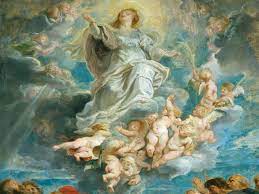
Eps 3: The Assumption of Mary
In the podcast titled "The Assumption of Mary," the speaker discusses the Catholic belief that Mary, the mother of Jesus, was assumed into heaven after her death. The doctrine of the Assumption states that Mary's body and soul were taken up to heaven without experiencing decay. This belief has its origins in early Christian traditions and was officially declared as an infallible dogma by Pope Pius XII in 1950. The podcast explains that the Assumption of Mary is distinct from the Ascension of Jesus. While Jesus ascended to heaven by his own power, Mary's assumption is seen as a divine act of grace. The speaker mentions biblical passages and early Christian writings that support this belief, even though there is no explicit scriptural account of Mary's assumption. The speaker also explores the historical development and theological significance of the Assumption. It is noted that the belief in Mary's heavenly assumption existed in various forms throughout history, but it was not until the 20th century that it became a formal dogma of the Catholic Church. The Assumption is seen as a reflection of Mary's unique role as the mother of Jesus and her exemplary life of faith and obedience. Furthermore, the podcast delves into the significance of the Assumption for Catholics. It is seen as a source of hope and a reminder of the ultimate destiny that awaits believers. The Assumption also highlights Mary's special intercessory role in Catholic devotion, as she is believed to be actively involved in the lives of believers and able to pray for their needs. In summary, the podcast discusses the Catholic doctrine of the Assumption of Mary, which asserts that Mary was taken up into heaven after her death. It examines the origins, historical development, and theological significance of this belief, highlighting its importance in Catholic devotion and spirituality.
| Seed data: | Link 1 |
|---|---|
| Host image: | StyleGAN neural net |
| Content creation: | GPT-3.5, |
Host

Randy Adams
Podcast Content
In the realm of Christian beliefs, the Assumption of Mary holds a special place. It is a doctrine that has been embraced by the Catholic Church, as well as some Eastern Orthodox Christians. The Assumption refers to the belief that Mary, the mother of Jesus, was taken up into heaven, body and soul, at the end of her earthly life. This event, which is not explicitly mentioned in the Bible, has sparked centuries of theological reflection and devotion.
The roots of the belief in the Assumption can be traced back to ancient Christian traditions and writings. While the New Testament does not provide specific details about the end of Mary's life, it does mention her central role in the early Church. Mary's unique status as the Mother of God and her significant presence in Jesus' life have led many to ponder upon her fate after her time on earth.
One early Christian document that sheds light on the Assumption is the Transitus Mariae, a text dating back to the fifth or sixth century. This apocryphal work describes how Mary's soul was taken by angels to heaven, where she was reunited with her son, Jesus. While not considered canonical by the Church, the Transitus Mariae illustrates the early development of the belief in Mary's Assumption.
Over time, the belief in the Assumption grew and became deeply embedded in Christian tradition. In the Middle Ages, the Assumption was widely accepted by theologians and laity alike. Artworks depicting Mary's Assumption, such as paintings and sculptures, became popular during this period. Pilgrimages to shrines dedicated to the Assumption, like the famous Lourdes in France, still attract millions of faithful believers seeking solace and blessings.
In 1950, Pope Pius XII officially declared the Assumption of Mary as a dogma of the Catholic Church. This proclamation confirmed the longstanding belief and made it an official article of faith. According to the dogma, Mary's Assumption is seen as the culmination of her life as the mother of Jesus and her role as the perfect disciple. By uniting herself completely with the will of God, Mary is believed to have been given this special privilege.
The Assumption of Mary is significant for several reasons. Firstly, it reaffirms the elevated status that Mary holds in Christian theology. As the mother of Jesus, Mary played a pivotal role in the salvation story and was chosen to participate in God's plan in a unique way. Her Assumption serves as a confirmation of her importance and a reminder of her faithfulness and devotion.
Secondly, the Assumption serves as a physical manifestation of hope for believers. Mary's Assumption into heaven offers the promise that all who faithfully follow God can look forward to eternal bliss in the afterlife. It provides a glimpse into the ultimate destiny of humanity and serves as a source of inspiration and encouragement for believers striving to live a life of holiness and righteousness.
Lastly, the Assumption of Mary reflects the beauty of divine grace. It testifies to God's power and mercy in elevating a simple, humble woman to a state of glory. In a world that often values status, power, and wealth, the Assumption highlights the value and significance of humility, obedience, and surrender to God's will. Mary's Assumption invites believers to reflect on the transformative power of God's grace in their own lives.
Although not universally accepted among Christians, the belief in the Assumption of Mary has undoubtedly shaped the understanding of the role of Mary in Christianity. It continues to inspire devotion, reflection, and theological exploration. The Assumption serves as a poignant reminder of the eternal hope and ultimate destiny that lies ahead for all believers in their journey of faith.