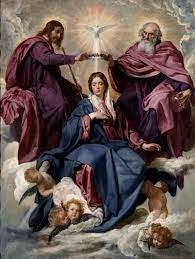
Eps 7: Queen of Heaven
The podcast episode titled "Queen of Heaven" discusses the historical and religious significance of the title "Queen of Heaven" given to the Virgin Mary. The host begins by explaining how different cultures throughout history have worshipped female deities associated with fertility, such as the Sumerian goddess Ishtar and the Egyptian goddess Isis. Moving forward, the host explores how the title "Queen of Heaven" came to be associated with Mary in Christian tradition. This development can be traced back to the early Church, where Mary's role as the mother of Jesus elevated her status. However, it wasn't until the Middle Ages that she started being referred to as the "Queen of Heaven." The host also mentions that while the phrase "Queen of Heaven" is found in the Bible, its interpretation and application in relation to Mary have varied among different branches of Christianity. In Catholicism, for instance, Mary is believed to have been crowned as the Queen of Heaven due to her unique role as the mother of God. She is seen as an intercessor and protector of humankind. The podcast concludes by highlighting the controversies surrounding the title "Queen of Heaven." Some Christians, particularly Protestants, argue that equating Mary with the Queen of Heaven mentioned in the Bible goes against the worship of only one God and can lead to idolatry. Nonetheless, the host emphasizes that for many believers, the title is a way to honor Mary's devotion and role in the Christian faith.
| Seed data: | Link 1 |
|---|---|
| Host image: | StyleGAN neural net |
| Content creation: | GPT-3.5, |
Host

Vickie Pearson
Podcast Content
Introduction:
Welcome to today's episode of "Queen of Heaven". In this episode, we will delve into one of the most intriguing and captivating figures in religious history - the Queen of Heaven. Throughout different cultures and religions, the concept of a divine feminine figure has persisted, taking on various names and forms. From ancient deities to modern-day perceptions, let us embark on a journey exploring the significance and symbolism associated with this powerful archetype.
Ancient Mesopotamian Origins:
Our first stop on this exploration takes us to ancient Mesopotamia. Here, we uncover the earliest known reference to the Queen of Heaven, known as Inanna or Ishtar. Ishtar was revered as the goddess of love, beauty, war, and fertility. She represented the balance of power and was considered the embodiment of feminine strength and intelligence. Ishtar's enduring legacy can be seen in various mythologies and religious traditions that followed.
The Virgin Mary:
Fast forward to the Christian tradition, and we encounter the Queen of Heaven in the form of the Virgin Mary. With her purity, compassion, and divine motherhood, Mary became a central figure within the Catholic Church. Devotion to the Queen of Heaven grew, with believers seeking solace and guidance through prayer and worship. Mary's iconic portrayal as a nurturing mother figure resonated with millions worldwide, making her an enduring symbol of maternal love.
Goddess Durga:
In Hinduism, we find the goddess Durga, another incarnation of the Queen of Heaven. Durga is depicted as a divine warrior, fiercely battling evil in the world. She combines compassion and strength and is widely worshipped during the annual festival of Navratri. Durga's multifaceted nature reflects the complexity and depth of the divine feminine, appealing to devotees seeking empowerment and protection.
The Black Madonna:
As we explore further, we encounter an intriguing representation of the Queen of Heaven known as the Black Madonna. This figure, often depicted with darker skin, holds significant cultural and historical symbolism. Found predominantly in Europe, the Black Madonna represents a fusion of pagan and Christian beliefs, inspiring awe and devotion. Many believe the Black Madonna embodies a primal connection to the earth and the mystical forces of nature.
Gaia and Mother Nature:
Beyond religious and mythological contexts, we encounter the Queen of Heaven archetype in the personification of Gaia or Mother Nature. Celebrated globally, Gaia embodies the Earth itself - nurturing, sustaining, and maintaining the delicate balance of life. She represents the interconnectedness of all beings and the need for harmony with the natural world. Interest in reconnecting with Gaia has surged in recent years as an urgent response to environmental crises facing our planet.
Conclusion:
From ancient Mesopotamia to the modern-day, the Queen of Heaven has left an indelible mark on human consciousness. Her presence, in various forms and names, continues to inspire, empower, and provide solace to believers seeking a connection to the divine feminine. As we explore these diverse interpretations, we come to appreciate the universal desire for a compassionate, nurturing, and protective force that transcends cultures, religions, and time. The Queen of Heaven rightfully holds her place as a symbol of reverence, reminding us of the invaluable role the feminine plays in shaping our world and our souls.