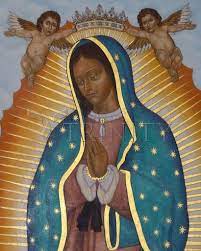
Eps 15: Our Lady of Guadalupe's Coronation
— The Mexican Marian Apparition Podcast
In this 10-minute podcast titled "Our Lady of Guadalupe's Coronation," the host explores the significance of the coronation of Our Lady of Guadalupe, a revered religious figure in Mexico. The podcast discusses how the coronation ceremony, which took place in 1895, marked a culmination of devotion and recognition for the Virgin Mary by the Catholic Church. The host explains that the coronation affirmed the intimate connection between the Virgin Mary and Mexican identity, as her appearance to Juan Diego in 1531 became a symbol of faith and unity for the country. The podcast also emphasizes the role of art in expressing and propagating the devotion to Our Lady of Guadalupe, highlighting the iconic image of her that is widely recognized and revered. The host concludes by stating that the coronation of Our Lady of Guadalupe serves as a testament to the enduring power and influence of religious faith in Mexican culture.
| Seed data: | Link 1 |
|---|---|
| Host image: | StyleGAN neural net |
| Content creation: | GPT-3.5, |
Host

Ronnie Rodriguez
Podcast Content
Welcome to another episode of our podcast, where we explore fascinating and significant events in history. Today, we delve into the captivating story of "Our Lady of Guadalupe's Coronation." This event holds tremendous significance in Mexican culture and Catholic tradition. Join us as we unravel the history and significance behind this coronation, which serves as an ultimate testament to faith and devotion.
Our story begins in the early 16th century, when a series of miraculous events unfolded in the hills of Tepeyac, near what is now Mexico City. According to tradition, on December 9, 1531, a humble indigenous peasant, Juan Diego, encountered the Virgin Mary on the hill. During their encounter, she revealed herself as the "Mother of the True God" and requested that a shrine be built in her honor at the site of their meeting.
Filled with self-doubt and incredulity, Juan Diego relayed the Virgin Mary's request to Mexico City's archbishop, Fray Juan de Zumárraga. However, the archbishop remained skeptical and demanded proof of this extraordinary encounter. Undeterred, Juan Diego returned to the hill, and on December 12, the Virgin Mary appeared once again, assuring him that she would provide evidence for the archbishop.
Instructed by the Virgin, Juan Diego climbed the hill to gather flowers. Remarkably, despite it being a cold winter, he found a variety of vibrant roses blossoming on the usually barren hilltop. Gathering them in his tilma, a traditional cloak made of cactus fibers, Juan Diego hurried to the archbishop's residence.
Upon arriving, Juan Diego unfolded his tilma to present the roses to the archbishop. However, what he discovered left everyone awe-stricken. On the tilma's fabric, an astonishing image of Our Lady of Guadalupe had miraculously appeared. The image showcased her dark skin, indigenous features, a radiant glow, and intricate symbolism significant to the indigenous people of Mexico.
Fray Juan de Zumárraga was profoundly moved by this miracle, and Mary's message of unity, compassion, and love resonated deeply with him. As news about the miraculous image spread rapidly, it captivated the hearts of the Mexican people. They considered it a clear sign of God's intervention and a profound validation of their faith and heritage.
This pivotal event marked the profound beginning of devotion to Our Lady of Guadalupe, who has since become one of Mexico's most revered figures and the patron saint of the Americas. As the centuries passed, the Basilica of Our Lady of Guadalupe was constructed at the site of the original apparition, becoming one of the most important pilgrimage sites for Catholics worldwide.
Moving forward in time to 1895, we arrive at the significant moment of Our Lady of Guadalupe's coronation. On October 12 of that year, Pope Leo XIII issued a papal bull authorizing the coronation of the Virgin of Guadalupe. The coronation ceremony was held on October 12, 1895, at the Basilica of Our Lady of Guadalupe, presided over by the archbishop, Ricardo Ortega y Perez, on behalf of the pope.
The coronation symbolized the recognition of the Virgin of Guadalupe's role in the spiritual journey of countless believers. It elevated the status of the image from a local devotion to global veneration, cementing her place as a universal symbol of Mary's maternal love and intercession. The coronation confirmed the significance of this apparition as a powerful source of inspiration and hope, not just for Mexicans but for Catholics worldwide.
Our Lady of Guadalupe's coronation solidified her celestial authority and brought an immense sense of pride and devotion to the Mexican people. She remains an enduring presence in the lives of millions, offering solace, healing, and guidance to those who seek her intercession. Today, devotees from around the world flock to the Basilica of Our Lady of Guadalupe, paying homage to the miraculous image and seeking her blessings.
The coronation of Our Lady of Guadalupe serves as a timeless reminder of the power of faith and the enduring impact of miracles. In this remarkable event, we witness the convergence of spirituality, history, and culture, creating a tapestry that unites people across time and borders. The story of Our Lady of Guadalupe's coronation reminds us that sometimes, in the realm of faith, inexplicable and extraordinary events can unfold, igniting the flames of devotion and transforming lives forever.
As we conclude this episode, we invite you to reflect on the enduring legacy of Our Lady of Guadalupe and the profound impact of her coronation. This event represents a testament to the unbreakable bond between humanity and divinity, a bond fortified by love, faith, and miracles. From the humble hills of Tepeyac to the hearts of millions, the story of Our Lady of Guadalupe's coronation continues to illuminate the beauty and power of devotion. Thank you for joining us today, and be sure to tune in next time for another captivating episode of our podcast.