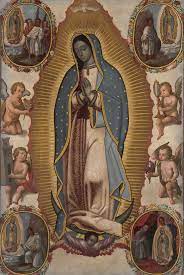
Eps 52: Our Lady of Guadalupe, queen for the Aztecs and Native Americans, intercede for me
— The Moments About the Virgin Mary in the Role as the Mother of God
The podcast discusses the significance of Our Lady of Guadalupe as a revered figure for both the Aztecs and Native Americans. The host explains that when the Spanish arrived in Mexico, they encountered the Aztec Empire, which had its own religious beliefs centered around goddesses, including Tonantzin. The Spanish attempted to suppress the native religions and imposed Catholicism. However, Our Lady of Guadalupe's appearance is seen as a merging of both cultures, as she appeared to a native Aztec man named Juan Diego in 1531. The image of the Virgin Mary, as she appeared to Juan Diego, is considered significant because it resembles both a Spanish Madonna and an Aztec goddess. The host highlights that Our Lady of Guadalupe is worshipped by a diverse group of people, including Mexicans, Mexican-Americans, and Native Americans. Devotees believe in her power to intercede on their behalf, making her a symbol of hope and solace during times of struggle. Overall, the podcast explores the historical and cultural importance of Our Lady of Guadalupe as a unifying figure for various communities.
| Seed data: | Link 1 |
|---|---|
| Host image: | StyleGAN neural net |
| Content creation: | GPT-3.5, |
Host

Ronnie Shaw
Podcast Content
Introduction:
Welcome to today's podcast, where we will delve into the fascinating story of one of the most revered religious figures in the Americas - Our Lady of Guadalupe. This title was bestowed upon a beautiful apparition of the Virgin Mary that appeared in 1531 in Mexico. The significance of Our Lady of Guadalupe goes beyond religious devotion; she embodies a powerful symbol of unity, offering hope, comfort, and intercession for countless believers. Join us as we explore the story behind the apparition and analyze the enduring impact she has had on the lives of the Aztecs, Native Americans, and people around the world.
The Apparition of Our Lady:
In December 1531, a humble indigenous peasant man named Juan Diego claims to have witnessed a miraculous apparition of the Virgin Mary on Tepeyac Hill, just outside Mexico City. The lady identified herself as the "ever-virgin Holy Mary, mother of the true God" and requested Juan Diego to build a chapel at the site in her honor. Juan Diego faithfully relayed this message to the local bishop, Juan de Zumárraga, who responded skeptically. However, the Blessed Virgin appeared to Juan Diego multiple times, leaving an indelible imprint of her image on his cloak as evidence. This "tilma" containing the image of Our Lady of Guadalupe stands as a miraculous relic that continues to inspire millions of faithful followers today.
Historical and Cultural Context:
To fully understand the significance of Our Lady of Guadalupe, we must consider the historical and cultural backdrop of the time. The apparition occurred a decade after the fall of the Aztec empire to the Spanish conquistadors. The indigenous people, who were living under a new colonial regime, were grappling with a loss of identity and spiritual turmoil. The arrival of Our Lady of Guadalupe, with her dark skin and indigenous features, offered solace and a connection to their rich pre-colonial heritage. This representation of the Virgin Mary resonated deeply with the indigenous population, as she bridged the gap between their past beliefs and the introduced Catholicism.
Intercession and Divine Intervention:
Our Lady of Guadalupe's role as an intercessor has been a fundamental aspect of her veneration. Countless stories of miraculous healings, protection, and answered prayers have been attributed to her intercession. People from all walks of life, from the poor and oppressed to the powerful and influential, have sought solace and divine intervention through their devotion to Our Lady of Guadalupe. Her appearance, during a time of great cultural upheaval, that emphasized her acceptance and inclusivity, offered hope and a renewed sense of purpose for the indigenous people.
Symbolism and Significance:
The symbolism within the image of Our Lady of Guadalupe is rich and profound. Her appearance on Juan Diego's cloak reveals a blending of Catholic and Aztec influences. Her dark skin, a characteristic of the indigenous people, signifies their unique position as the bearers of Christian faith. The stars on her mantle symbolize the cosmos, and the crescent moon beneath her feet represents the Aztec's moon goddess, demonstrating a harmonious integration of different cosmological beliefs. Thus, Our Lady of Guadalupe serves as an emblem of resilience, cultural unity, and the power of divine intervention.
Legacy and Worldwide Devotion:
The devotion to Our Lady of Guadalupe spreads far beyond the borders of Mexico. Her influence extends to Spanish conquistadors, Native Americans, and countless others who are drawn to her message of compassion, acceptance, and hope. Her image has been replicated in churches, homes, and religious artifacts worldwide, becoming an icon in both religious and popular culture. Annual pilgrimages to her shrine in Mexico City attests to the enduring devotion and faith of millions who seek her guidance and intercession.
Conclusion:
The story of Our Lady of Guadalupe is not confined to a singular religious belief. It represents a shared heritage, uniting cultures, and embracing diversity. Our Lady of Guadalupe, as the queen for the Aztecs and Native Americans, continues to intercede for those in need, offering solace, guidance, and the chance to reconnect with one's roots. May her powerful presence and unwavering love serve as an inspiration for all, reminding us of the strength that lies in unity and the transformative power of faith.