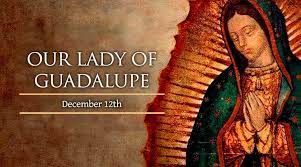
Eps 37: Our Lady of Guadalupe 12th of December
— The Mexican Marian Apparition Podcast
In a 10-minute podcast titled "Our Lady of Guadalupe 12th of December," the speaker discusses the significance and history of the celebration surrounding the religious figure Our Lady of Guadalupe, which takes place every year on December 12th. The speaker explains that according to the story, the Virgin Mary appeared to an indigenous man named Juan Diego in Mexico in 1531 and left her image imprinted on his tilma (cloak). This event, known as the Apparition of Our Lady of Guadalupe, is considered a pivotal moment in Catholicism and is believed to have played a crucial role in the conversion of many indigenous people to Christianity. The podcast further explores how the image of Our Lady of Guadalupe became an important symbol of Mexican identity and continues to be venerated by millions of people worldwide. It also delves into the various customs and traditions associated with the December 12th celebration, including pilgrimages, processions, and Masses. Overall, the podcast sheds light on the cultural and religious significance of Our Lady of Guadalupe and the widespread devotion she inspires.
| Seed data: | Link 1 |
|---|---|
| Host image: | StyleGAN neural net |
| Content creation: | GPT-3.5, |
Host

Gertrude Boyd
Podcast Content
The 12th of December marks an important day of celebration for the Mexican people and for Catholics around the world. It is the feast day of Our Lady of Guadalupe, also known as the Virgin of Guadalupe. This title and devotion to the Virgin Mary is highly revered in Mexico, where she is considered the patroness of the country. The story of Our Lady of Guadalupe is not only a deeply spiritual one, but also represents the merging of indigenous culture and Catholicism, making it a symbol of Mexican identity and heritage.
The story of Our Lady of Guadalupe dates back to the 16th century, when the Spanish conquistadors had arrived in Mexico. It was during this time that the Virgin Mary is said to have appeared to a humble indigenous man named Juan Diego, on the hill of Tepeyac. According to the accounts, Mary spoke to Juan Diego in his native Nahuatl language, which was a significant gesture as it demonstrated her desire to connect with the indigenous people. She asked Juan Diego to build a church in her honor on that very site.
However, Juan Diego was initially met with skepticism when he relayed this divine encounter to the local bishop, Juan de Zumárraga. The bishop requested for some sort of proof that this apparition was indeed Mary herself. In response, Mary appeared to Juan Diego again and instructed him to gather flowers that were growing miraculously on the hill, despite it being winter. Juan Diego obediently collected the flowers in his cloak, known as a tilma, and presented them as evidence to the bishop.
As Juan Diego opened his cloak to reveal the flowers, a miraculous image of the Virgin Mary was imprinted on the fabric. This image, known as the Virgin of Guadalupe, has become one of the most recognizable and venerated representations of Mary. Saint Juan Diego's tilma, which still exists today, is displayed in the Basilica of Our Lady of Guadalupe in Mexico City, attracting millions of pilgrims each year.
The image of Our Lady of Guadalupe holds great significance for both religious and cultural reasons. The dark-skinned Virgin Mary represents a powerful message of unity and inclusivity, as she is depicted as a mestiza, or of mixed race. This has resonated deeply with the Mexican people, who are descendants of both European and indigenous heritage.
Additionally, the devotion to Our Lady of Guadalupe played a vital role in the evangelization of Mexico. Many indigenous people were hesitant to adopt Catholicism due to the traumatic history of colonization. However, the apparition of the Virgin Mary as an indigenous woman helped bridge the gap between the two cultures and facilitated the conversion of millions of indigenous people to Catholicism.
The feast day of Our Lady of Guadalupe is celebrated with great fervor and enthusiasm in Mexico. Pilgrims from all over the country, and even from other parts of the world, travel to the Basilica of Our Lady of Guadalupe in Mexico City to pay homage to the Virgin Mary. The celebrations begin the night before with processions, music, fireworks, and traditional dances. On the 12th of December, a Mass is held to honor Our Lady of Guadalupe, and the faithful offer prayers, flowers, and candles as acts of devotion.
Beyond its religious significance, the celebration of Our Lady of Guadalupe has also become a symbol of Mexican culture. The image of the Virgin of Guadalupe can be seen everywhere in Mexico, from churches to homes, and even on t-shirts and murals. She is often referred to as the "Queen of Mexico," and her image is deeply ingrained in the Mexican identity.
In conclusion, the feast day of Our Lady of Guadalupe on the 12th of December holds immense importance for both religious and cultural reasons. The story of the Virgin Mary's apparition to Juan Diego serves as a powerful symbol of unity, inclusivity, and the merging of indigenous culture with Catholicism. The devotion to Our Lady of Guadalupe continues to inspire millions of people, not only in Mexico but around the world, reminding them of the profound connection between faith, heritage, and identity.