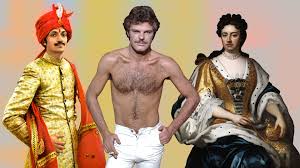
Eps 24: LGBTQ Monarchs Of Europe
— History
The podcast discusses the lives and reigns of various LGBTQ monarchs in European history, highlighting their contributions, challenges, and the impact of their sexual orientations and gender identities on their reigns and legacies. It delves into specific rulers, such as Queen Christina of Sweden, known for her unconventional life and relationships, and King James VI and I of Scotland and England, who had intimate relationships with men. The narrative acknowledges the difficulties these monarchs faced due to societal norms and pressures. Additionally, it explores the ways in which their identities influenced their policies, court life, and personal decisions. The podcast presents a nuanced view of how these LGBTQ monarchs navigated their personal and public lives within the context of their time periods.
| Seed data: | Link 1 |
|---|---|
| Host image: | StyleGAN neural net |
| Content creation: | GPT-3.5, |
Host

Heather Johnston
Podcast Content
Next on our list is Tsar Ivan IV of Russia, commonly known as Ivan the Terrible, who reigned from 1547 to 1584. In the harsh political landscape of his time, whispers and documents hint at relationships that transcended conventional heterosexual norms, although definitive evidence remains elusive. Now, let’s head to the 17th century, where we encounter William III of England. His close relationships with certain male courtiers led to widespread gossip, though the extent and nature of these relationships are still debated among historians.
In the 18th century, we'll meet Queen Anne of Great Britain. Her deep bonds with Sarah Churchill, Duchess of Marlborough, and later Abigail Masham, have led some to speculate that these were more than mere friendships. While the historical record is inconclusive, the emotional intensity of these relationships is well recorded.
Journeying to France, we uncover the life of Philippe I, Duke of Orléans, the younger brother of King Louis XIV. Philippe's open relationships with men at court were an open secret, and he was strikingly unapologetic for his time.
Jumping to the 20th century, we find King Umberto II of Italy, whose brief reign in 1946 was marred by rumors of his homosexuality, adding a subtle layer of scandal to a period of political upheaval. Across the continent, Crown Prince Rudolf of Austria-Hungary, known for his tragic end in 1889, had a complex personal life that allegedly included relationships with both men and women.
Our exploration wouldn't be complete without mentioning Queen Marie Antoinette of France, whose intimate friendships with women led to scandalous rumors that have persisted through centuries, despite the lack of concrete evidence.
Lastly, let’s not forget Prince George, Duke of Kent, an openly bisexual member of the British royal family in the early 20th century. His romantic liaisons with both men and women were the subject of numerous biographies, reflecting the shifting norms of his time.
These monarchs, with their nuanced lives, navigated their roles while embodying a spectrum of sexual and romantic identities that challenged and defied the conventions of their eras. Their stories remind us of the diverse tapestry of human experience that exists even within the most exalted of societal roles.