Eps 2438: John 1:1-14 (KJV)
— The too lazy to register an account podcast
The podcast discusses the first 14 verses of the Gospel of John from the King James Version of the Bible. These verses introduce the concept of the Word (Logos), stating that in the beginning was the Word, and the Word was with God, and the Word was God. It highlights the Word's role in creation, life, and light. John the Baptist's role is briefly mentioned as a witness to testify about the Light. The podcast emphasizes that the Word became flesh and dwelt among humanity, revealing the glory of the one and only Son, full of grace and truth.
| Seed data: | Link 1 |
|---|---|
| Host image: | StyleGAN neural net |
| Content creation: | GPT-3.5, |
Host

Vincent Jensen
Podcast Content
In Him was life, and that life was the light of men. The light shines in the darkness, and the darkness comprehended it not. Here, John juxtaposes light and darkness, representing truth and ignorance or evil, respectively. Jesus, the embodiment of life and light, came into the world to illuminate the hearts and minds of people, guiding them away from the shadows of sin and ignorance towards the truth of God.
The narrative continues by introducing John the Baptist, a man sent from God, whose purpose was to bear witness of the Light, that through him all might believe. John was not the Light but was sent to testify about the Light. This distinction clarifies John's role as a precursor, preparing the way for the true Light, which lights every person coming into the world.
The passage shifts to a somber reflection on human nature: He was in the world, and the world was made by Him, and the world knew Him not. He came unto His own, and His own received Him not. Despite being the Creator, Christ was not recognized or accepted by those He came to save, pointing to the tragic irony of the human condition. However, to those who did receive Him, who believed in His name, He gave the power to become the sons of God, even to those who believe on His name. Here, the text offers a message of hope and redemption, emphasizing belief in Christ as the pathway to becoming children of God.
This transformative power is described not as a physical birth but a spiritual rebirth, born not of blood, nor of the will of the flesh, nor of the will of man, but of God. This divine intervention underscores the new birth as a supernatural act of God, beyond human capacity or effort.
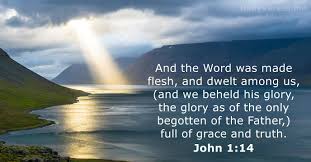
The passage culminates in the powerful declaration: And the Word was made flesh, and dwelt among us, full of grace and truth. This incarnation, where the eternal Word takes on human form and lives among us, stands at the heart of Christian belief. In Christ, the fullness of divine grace and truth is revealed, offering a glimpse of God's glory, the glory of the only begotten of the Father.
In these verses, John eloquently presents the dual nature of Christ as both fully divine and fully human, bridging the gap between heaven and earth. This profound mystery of the Word becoming flesh speaks to God's immense love and desire to be intimately involved in human life, a theme that continues to resonate and inspire believers throughout the centuries.