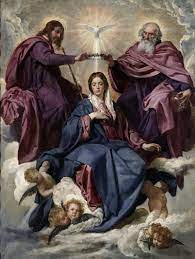
Eps 111: If the Mother of Jesus is the Queen of Heaven
The podcast titled "If the Mother of Jesus is the Queen of Heaven" explores the concept of Mary, the mother of Jesus, being referred to as the Queen of Heaven. The host discusses the origins of this belief and its significance within different Christian denominations. The term "Queen of Heaven" is found in the Bible, specifically in the Book of Jeremiah, which describes God's anger over the worship of a pagan goddess with the same title. However, many Christians interpret this title as a metaphorical representation of Mary's exalted status as the mother of Jesus. The podcast highlights that while some Christian traditions, such as the Catholic Church, strongly uphold this belief and celebrate Mary's role as the Queen of Heaven, others, like Protestant denominations, do not give her the same level of recognition. The discussion also touches upon the theological arguments for and against this belief, including debates on Mary's intercessory role and her relationship to Christ and the Kingdom of Heaven. Overall, the podcast provides an overview of the diverse perspectives on Mary's title as the Queen of Heaven within Christianity.
| Seed data: | Link 1 |
|---|---|
| Host image: | StyleGAN neural net |
| Content creation: | GPT-3.5, |
Host

Gail Sullivan
Podcast Content
Throughout history, Mary, the mother of Jesus, has held an esteemed position within Christianity. She is revered as the chosen vessel through which God entered the world and performed his miraculous act of salvation. While there is a general consensus among Christians regarding Mary's unique role, there are differences in opinion when it comes to her title and status as the "Queen of Heaven."
Those who support the notion that Mary is the Queen of Heaven do so based on a combination of scripture, tradition, and theological reasoning. The Bible does not explicitly proclaim Mary as the Queen of Heaven, but it does offer insight into her privileged position. In the Gospel of Luke, Mary is visited by the angel Gabriel, who greets her with the words, "Hail, full of grace, the Lord is with you" (Luke 1:28). This salutation suggests that Mary was chosen by God before her conception to be specially favored and set apart from other women.
Furthermore, the Gospel of Luke also refers to Mary as "blessed among women" and records her prophetic words, known as the Magnificat, in which she praises God for choosing her and magnifying her lowly state (Luke 1:42-55). These biblical passages highlight Mary's unique position as the mother of Jesus and her pivotal role in God's plan for salvation. Supporters of Mary's title as the Queen of Heaven argue that these biblical references are indicative of her exalted status.
In addition to biblical evidence, the concept of Mary as the Queen of Heaven is also rooted in the traditions of the Catholic Church. Since the earliest centuries, Mary has been venerated and honored as the Queen of Heaven by Christians around the world. The Catholic Church teaches that Mary's role as Queen is intimately connected to her role as the mother of Jesus, who is often referred to as the King of Kings.
In this understanding, Mary's Queenship is not a ruling position in the earthly sense, but rather a position of honor and intercession. She is believed to play a significant role in advocating for humanity and interceding on our behalf before the heavenly court. This belief finds support in the Book of Revelation, where John sees a vision of a woman clothed with the sun, crowned with twelve stars, and standing on the moon (Revelation 12:1). Catholics interpret this woman as Mary, symbolizing her heavenly Queenship.
However, not all Christians accept the idea of Mary as the Queen of Heaven. Many Protestant denominations do not hold the same level of veneration and honor for Mary as the Catholic Church does. They argue that elevating Mary to the position of Queen of Heaven detracts from the sole lordship of Jesus Christ and his role as the mediator between God and humanity.
Furthermore, opponents of Mary's Queen title contend that it is not supported by clear biblical evidence. They argue that the passages in Luke and Revelation, while highlighting Mary's unique role, do not explicitly establish her as the Queen of Heaven. They also caution against the danger of elevation and worship of Mary to the point of overshadowing Jesus.
In conclusion, the question of whether the Mother of Jesus is the Queen of Heaven is one that has sparked theological debates and differences of opinion within Christianity. Proponents of Mary's Queenship point to biblical passages and centuries-old traditions as evidence of her exalted status. However, opponents argue that such a title detracts from Jesus' unique role as the King of Kings. Ultimately, whether Mary is recognized as the Queen of Heaven or not, her significant role in the story of salvation remains undeniable, and her example of humility and surrender to God's will serves as an inspiration for believers today.