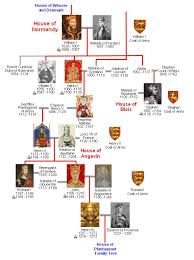
Eps 21: Family Tree of the house of Normandy
— history
The House of Normandy has its roots in Viking settlers who established themselves in what is now Normandy, France. The founder, Rollo, secured his position and established the lineage, which saw his descendants become significant medieval European figures. His great-great-grandson, William the Conqueror, became Duke of Normandy and later King of England after the Battle of Hastings in 1066. William's children further entwined Normandy's fate with England; his son, William II, ruled England, and another son, Henry I, strengthened the dynasty through strategic marriages and military campaigns. Henry's lineage continued to influence English and European politics, culminating in complex feuds over succession and territorial claims. The House's legacy persisted through strategic alliances and battles, shaping the medieval history of both England and Normandy.
| Seed data: | Link 1 |
|---|---|
| Host image: | StyleGAN neural net |
| Content creation: | GPT-3.5, |
Host

Carla Fisher
Podcast Content
William's reign as William I of England catalyzed transformative changes, weaving Norman governance, legal frameworks, and cultural elements into English society. His consolidation of power and establishment of feudalism laid the groundwork for a lasting legacy. His union with Matilda of Flanders bore several children, most notably Robert Curthose, William II Rufus, and Henry I. The succession after William’s death was fraught with tension. William II, the second son, became king but his reign ended abruptly with his mysterious death in 1100, paving the way for Henry I to claim the throne. Henry's rule was marked by administrative reforms and efforts to stabilize the kingdom, including the controversial marriage to Edith of Scotland, blending Norman and Anglo-Saxon lineages.
Tragedy struck with the untimely death of Henry’s son, William Adelin, in the White Ship disaster of 1120, thrusting the dynasty into a succession crisis. Henry’s daughter, Empress Matilda, emerged as a key figure, although her claim was contested by her cousin Stephen of Blois, igniting a protracted civil war known as The Anarchy. Ultimately, the conflict concluded with the Treaty of Wallingford in 1153, stipulating that Matilda’s son, Henry Plantagenet (later Henry II), would inherit the throne, initiated the Angevin dynasty.
The House of Normandy’s influence extended beyond England. Through strategic marriages and military conquests, they impacted realms such as Sicily and Southern Italy, founding a lasting legacy through figures like Roger II of Sicily. This intricate web of alliances and territorial acquisitions testified to the Normans’ far-reaching power. The assimilation of Norman customs and legal systems in these territories echoed their transformative impact across medieval Europe.
By examining the House of Normandy’s lineage, with its dramatic ascents and turbulent crises, we gain insight into the shaping of medieval European politics, culture, and society. Their legacy, interwoven with conquest, governance, and dynastic strife, paints a vivid portrait of a dynasty that dramatically redefined the European landscape during their reign. The Normans' ability to blend different cultures and implement their governance structures solidified their place as pivotal architects of European history, their impact enduring well beyond their era.