Eps 61: Educational Strategies: Deep Dive into Bloom's Taxonomy Cognitive Domain
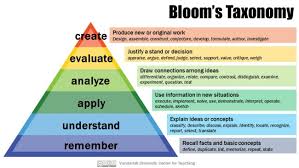
The podcast provides an in-depth exploration of Bloom's Taxonomy's Cognitive Domain, a framework for categorizing educational goals. It explains the six levels of cognitive skills: Remembering, Understanding, Applying, Analyzing, Evaluating, and Creating. Starting with Remembering, the lowest level involves recalling facts and basic concepts. Understanding involves explaining ideas. Applying refers to using information in new situations. Analyzing involves breaking information into parts to explore relationships. Evaluating entails making judgments based on criteria. Creating, the highest level, involves producing new or original work. The podcast highlights practical strategies for educators to design lessons and assessments that incorporate these levels to enhance student learning and critical thinking skills.
| Seed data: | Link 1 |
|---|---|
| Host image: | StyleGAN neural net |
| Content creation: | GPT-3.5, |
Host

Lee Franklin
Podcast Content
At the base of the taxonomy is "Remember," which emphasizes the retrieval of relevant knowledge from long-term memory. This is where learners recall facts, definitions, and basic concepts. Moving up, "Understand" shifts the focus to comprehending the meaning, translation, interpolation, and interpretation of instructions and problems. This involves explaining ideas or concepts in one's own words.
Next is "Apply," the stage where learners use the information in new and concrete situations by executing or implementing tasks. This is crucial for transferring theoretical knowledge into practice, often seen in problem-solving activities. Following that is "Analyze," requiring learners to break information into parts and understand its structure. During this stage, students identify relationships, differentiate between components, and recognize organizational principles.
The fifth level, "Evaluate," involves making judgments based on criteria and standards. This encompasses critiquing ideas, proposing alternatives, assessing theories, and evaluating the outcomes of decisions. It’s at this stage that learners justify their choices and assess the validity of arguments. Finally, "Create" sits at the apex of the cognitive domain. This level involves synthesizing information to produce new or original work. Here, learners generate hypotheses, design experiments, construct theories, or devise action plans.
Integrating Bloom's Taxonomy into educational strategies can significantly enhance the learning experience. By scaffolding instruction based on these cognitive levels, educators can design curricula that encourage higher-order thinking. This structured approach ensures that students progress from simple to complex and from concrete to abstract learning. Assessments aligned with Bloom's Taxonomy ensure that students are not only recalling information but also applying, analyzing, evaluating, and creating. This multidimensional approach prepares students for real-world challenges, fostering critical thinking, problem-solving, and innovative skills essential for success in an ever-evolving global landscape.