Eps 5: EDSA People Power Revolution and contemporary history in the Philippines
The podcast discusses the EDSA People Power Revolution in the Philippines, which took place in 1986 and led to the ousting of dictator Ferdinand Marcos. The revolution is seen as a pivotal moment in Philippine history, marking a shift towards democracy and inspiring similar movements around the world. However, the podcast also highlights the challenges and controversies that have arisen in the country since then, including issues of corruption, inequality, and political instability. Despite these challenges, the podcast emphasizes the importance of remembering and learning from the events of the revolution in order to create a more just and equitable future for the Philippines.
| Seed data: | Link 1 |
|---|---|
| Host image: | StyleGAN neural net |
| Content creation: | GPT-3.5, |
Host

Stacey Wade
Podcast Content
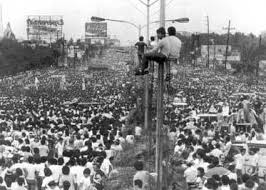
The EDSA People Power Revolution of 1986 is a pivotal event in Philippine history that continues to shape the country's politics and society to this day. This peaceful revolution, which saw millions of Filipinos gather on Epifanio de los Santos Avenue (EDSA) to overthrow the authoritarian regime of President Ferdinand Marcos, stands as a testament to the power of collective action and the yearning for democracy among the Filipino people.
The seeds of the revolution were sown in the years leading up to 1986, as Marcos' twenty-year rule became increasingly oppressive and corrupt. The Philippine economy was in shambles, with widespread poverty and inequality, while human rights abuses and political repression were rampant. The assassination of opposition leader Benigno Aquino Jr. in 1983 served as a catalyst for mass protest and resistance, culminating in the historic events of February 1986.
On February 22, 1986, a group of military officers led by Defense Minister Juan Ponce Enrile and Armed Forces Vice Chief of Staff Fidel Ramos defected from Marcos' government and barricaded themselves in Camp Crame. Thousands of civilians, spurred on by the call of the Catholic Church and opposition leaders such as Corazon Aquino, converged on EDSA to show their support for the rebels and demand Marcos' resignation.
What followed was an awe-inspiring display of people power, as millions of Filipinos from all walks of life gathered on the streets of Manila, armed with nothing but their faith in the power of nonviolent resistance. The "Yellow Revolution," named after the color worn by supporters of Aquino, unfolded peacefully over four days, with the military ultimately siding with the people and refusing to fire on the crowds.
On February 25, 1986, Marcos fled the country with his family, leaving behind a nation profoundly changed by the events of EDSA. Corazon Aquino was sworn in as the new president, marking the first peaceful transfer of power in Philippine history and ushering in a new era of democracy and freedom.
The legacy of the EDSA People Power Revolution reverberates through contemporary Philippine society, serving as a constant reminder of the importance of safeguarding democracy and upholding the rule of law. The spirit of EDSA lives on in the hearts of Filipinos who continue to fight for justice, equality, and accountability in the face of an ever-changing political landscape.
The lessons of EDSA are especially relevant today, as the Philippines grapples with a resurgence of authoritarianism under President Rodrigo Duterte. In a country plagued by extrajudicial killings, media censorship, and attacks on democratic institutions, the memory of EDSA serves as a beacon of hope for those who refuse to yield to tyranny and oppression.
As we reflect on the legacy of the EDSA People Power Revolution and its impact on contemporary Philippine history, it is clear that the struggle for democracy is far from over. It is up to each and every one of us to carry on the spirit of EDSA and ensure that the sacrifices made by those who fought for freedom and justice are not in vain. Only by standing together and upholding the values of truth, justice, and democracy can we truly honor the legacy of EDSA and build a better future for all Filipinos.