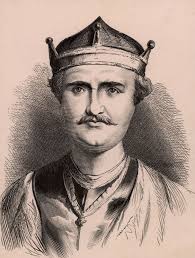
Eps 22: Biography Of William The Conqueror
— history
William the Conqueror, originally named William I, was born in 1028 in Falaise, Normandy, as the illegitimate son of Robert I, Duke of Normandy, and Herleva, a tanner's daughter. Despite his illegitimacy, William inherited his father's title at the young age of eight after Robert's death. His early rule was fraught with challenges, including continuous uprisings and threats to his position. Overcoming these difficulties, William solidified his power through strategic alliances and ruthless measures. In 1066, William made a historic move by launching the Norman invasion of England. The decisive Battle of Hastings on October 14, 1066, saw William defeat King Harold II, leading to his coronation as King of England on December 25, 1066. This victory marked the beginning of Norman rule in England and significant cultural and administrative changes. William implemented the feudal system, redistributed land to his Norman supporters, and commissioned the Domesday Book in 1086, a comprehensive survey of his new kingdom's assets. His reign profoundly influenced the English language, law, and societal structures. William died in 1087, leaving a legacy as a transformative figure in European history.
| Seed data: | Link 1 |
|---|---|
| Host image: | StyleGAN neural net |
| Content creation: | GPT-3.5, |
Host

Sheila Griffin
Podcast Content
In October 1066, William and his Norman forces defeated Harold's army at the Battle of Hastings. His victory was not merely a military triumph but a transformative moment for England. Crowned King of England on Christmas Day of that year, William faced constant rebellion but managed to consolidate his power through a blend of ruthless campaigns and strategic land distributions. His reign radically altered the English landscape, both physically and culturally. The introduction of Norman landholding systems and the construction of monumental castles like the Tower of London underscored his commitment to securing his realm.
Administering his new kingdom with an iron fist, William commissioned the Domesday Book in 1086, a meticulous survey of his conquered lands, showcasing his administrative precocity. His governance welded Norman and Anglo-Saxon cultures, although often to the detriment of the latter, and fundamentally redefined English aristocracy. Despite his harsh methods, William's legacy is profound; he laid the foundation for modern England. William's death in 1087, the result of injuries from a horse-riding accident, did not diminish his impact. His lineage, the Norman dynasty, continued to shape English politics and culture long after his passing. William the Conqueror stands as a pivotal figure whose ambition and administrative genius irrevocably transformed the course of English history.