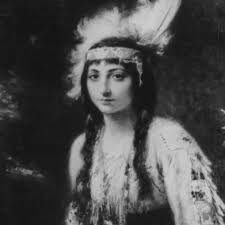
Eps 94: Biography Of The Real Pocahontas
The podcast delves into the life of Pocahontas, a Native American woman belonging to the Powhatan tribe in present-day Virginia. Born around 1596, her real name was Amonute, and she also had the private name Matoaka. The name Pocahontas was a nickname meaning "playful one." The narrative covers her interaction with the English settlers, particularly her notable relationship with John Smith, which has been romanticized over time. Multiple sources suggest that she played a role in mediating relations between her tribe and the settlers, although the details are often debated. The podcast illustrates how Pocahontas was eventually captured by the English in 1613 and held for ransom. During her captivity, she converted to Christianity and took the name Rebecca. She married John Rolfe, an English tobacco planter, which was a significant event as it symbolized a period of relative peace between the settlers and the Powhatan tribe. The couple had a son, Thomas Rolfe. Pocahontas traveled to England in 1616, where she was presented to English society as an example of a "civilized savage" to encourage investment in the Jamestown settlement. She died in March 1617 in England due to illness and was buried in Gravesend. Her legacy is complex, often viewed through the lenses of both cultural assimilation and resistance.
| Seed data: | Link 1 |
|---|---|
| Host image: | StyleGAN neural net |
| Content creation: | GPT-3.5, |
Host

Heather Johnston
Podcast Content
According to English accounts, Pocahontas saved the life of Captain John Smith from execution by her father, though this event’s accuracy is debated among historians. Nonetheless, her interactions with the colonists were pivotal. Pocahontas fostered a tenuous peace between her people and the settlers through diplomacy and her ability to cross cultural lines. She played a crucial role during the early years of the Jamestown colony, serving as a liaison and occasionally bringing food to the struggling English.
In 1613, Pocahontas was captured by the English and held for ransom during hostilities with the Powhatan Confederacy. During her captivity, she was treated with respect and became a point of fascination. It was then that she converted to Christianity and was baptized Rebecca. Pocahontas married John Rolfe, a prominent tobacco planter, in 1614. This marriage is often credited with bringing a period of relative peace between the English settlers and Powhatan's tribes, known as the Peace of Pocahontas.
In 1616, Pocahontas traveled to England with her husband and infant son, Thomas. She was presented to English society as an example of the civilized "savage" and met King James I and Queen Anne. Unfortunately, her visit was cut short when she fell ill and died in March 1617 at about 21 years old. She was buried in Gravesend, England.
Pocahontas’s legacy is a complex tapestry of myth and reality. She remains a symbol of cross-cultural understanding and, unfortunately, the tragic consequences of colonialism. Her story reflects the deep cultural intersections and the profound impact of colonial encounters, offering poignant lessons about the early contact between Native Americans and Europeans. By examining her real life, we can appreciate Pocahontas not just as a figure of folklore, but as a crucial historical figure whose life bridges the Native American and European worlds during a formative period in American history.