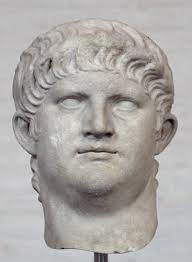
Eps 129: Biography Of Roman Emperor Nero
— History
Nero was the fifth Roman Emperor, ruling from 54 to 68 AD. Born Lucius Domitius Ahenobarbus in 37 AD, he was adopted by his great-uncle Claudius, becoming Nero Claudius Caesar Augustus Germanicus. His reign is marked by extravagant spending, massive building projects, and a notorious reputation for debauchery and tyranny. Early in his rule, Nero was influenced by his mother Agrippina, his tutor Seneca, and the Praetorian Prefect Burrus, but as he grew older, he sought more personal freedom, leading to conflicts and ultimately the assassination of his mother. He heavily indulged in the arts, famously performing as a musician and actor, scandalizing Roman society. His rule saw the Great Fire of Rome in 64 AD, which led to rebuilding efforts but also persecution of Christians, who were blamed for the fire. Discontent and revolts grew under his despotic governance. Facing rebellion and the loss of support from the Senate and the Praetorian Guard, Nero fled and committed suicide in 68 AD, ending the Julio-Claudian dynasty.
| Seed data: | Link 1 |
|---|---|
| Host image: | StyleGAN neural net |
| Content creation: | GPT-3.5, |
Host

Jared Morris
Podcast Content
Initially, Nero's rule was guided by his advisors, Seneca the Younger and Sextus Afranius Burrus, leading to a period often lauded for its moderate policies. However, as Nero grew older, his reign took a notorious turn towards tyranny and excess. His infamous actions included the alleged matricide of Agrippina in 59 AD and the politically motivated executions of his rivals. Nero's regime marked a significant shift towards autocratic rule, characterized by extreme acts of cruelty and lavish public entertainments. His extravagance extended to grandiose construction projects like the Domus Aurea, a massive palace complex built after the Great Fire of Rome in 64 AD, an event for which he scapegoated Christians, leading to their brutal persecution.
Nero's interest in the arts was a defining, albeit controversial, aspect of his reign. He fancied himself an accomplished actor and musician, often performing in public to mixed receptions. These pursuits, along with heavy taxation and economic strain, fueled widespread dissatisfaction within the Senate, military, and among the common populace. In 68 AD, a rebellion led by the governor of Hispania, Galba, forced Nero to flee the capital. He was subsequently declared a public enemy by the Senate. Cornered and facing execution, Nero chose to take his own life on June 9, 68 AD, uttering the famous words, "Qualis artifex pereo!" (“What an artist dies in me!”).
Nero's death marked the end of the Julio-Claudian dynasty, plunging the Roman Empire into a year of civil wars known as the Year of the Four Emperors. His reign remains a subject of historical debate, seen by some as the rule of a mad tyrant and by others as a misunderstood artist and reformer. Despite the contentious nature of his legacy, Nero's life continues to captivate historians and enthusiasts of Roman history.