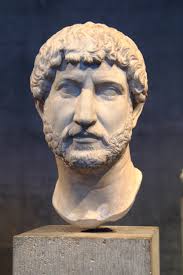
Eps 132: Biography Of Roman Emperor Hadrian
— History
Hadrian was a Roman Emperor from 117 to 138 AD, best known for his substantial and lasting contributions to the Roman Empire's infrastructure and his consolidation rather than expansion of its borders. Born in Italica, Hispania, in 76 AD, he rose to power as a relative and successor of Emperor Trajan. He undertook extensive travels across the Roman Empire, visiting nearly every province and focusing on fortifying the empire's frontiers, including the construction of Hadrian's Wall in Britain to keep out the Picts. Hadrian was a well-educated leader, deeply interested in Greek culture, which earned him the reputation of a Grecophile. His reign marked a shift from the military conquests that characterized his predecessor to an emphasis on cultural patronage, legal reforms, and architectural projects. Among his notable architectural contributions is the Pantheon in Rome, which was rebuilt under his orders. He also worked to balance civic and military priorities, improving the administration, creating fairer legal codes, and reforming tax systems. Despite initial periods of internal tension and conspiracy, Hadrian's rule stabilized and he is remembered as one of the so-called "Five Good Emperors," a group of emperors known for their effective governance. He died in 138 AD, setting a precedent for peaceful successions and leaving a legacy of architectural marvels and administrative reforms that significantly shaped the future of the Roman Empire.
| Seed data: | Link 1 |
|---|---|
| Host image: | StyleGAN neural net |
| Content creation: | GPT-3.5, |
Host

Ronnie Rodriguez
Podcast Content
Hadrian is best remembered for his extensive travels throughout the Roman Empire, an unusual characteristic for an emperor of his time. He spent more than half of his 21-year reign outside Italy, visiting almost every province. These travels were not mere grand tours; they had the pragmatic objective of consolidating and securing Rome's vast territories. Hadrian fortified borders, most famously by constructing Hadrian's Wall in Britannia, which marked the northern limit of Roman Britain. This wall, stretching 73 miles, was a formidable defensive structure designed to keep out the Picts from Scotland and contributed to Hadrian's reputation as a diligent and strategic ruler.
Internally, Hadrian enacted numerous reforms to stabilize and improve the economic and social structures of his empire. He reformed the legal system, giving more rights to ordinary citizens and restructuring the financial administration to restore economic stability. Hadrian’s passion for Greek culture earned him the moniker "Graeculus," or "Little Greek." His admiration for Greek art, philosophy, and literature influenced Roman society profoundly. He rebuilt the Pantheon in Rome with a magnificent dome that still stands today, a testament to his architectural ingenuity and his desire to blend Greek and Roman traditions.
The emperor's private life was also noteworthy. He was profoundly affected by the death of his young companion Antinous in 130 AD, whom he deified and immortalized by establishing cities and monuments in his memory, notably the city of Antinopolis in Egypt. Hadrian's personal grief translated into a mysterious and somewhat melancholic aura that surrounded the latter part of his reign.
Despite his numerous accomplishments, Hadrian's later years were marred by increasing health issues and political tensions, often due to his paranoia and autocratic tendencies. As his health declined, he spent his final years in his opulent villa at Tivoli, near Rome, where he died on July 10, 138 AD. Hadrian’s successor, Antoninus Pius, oversaw the emperor's deification, ensuring his enduring legacy.
Hadrian’s reign marked a pivotal period in Roman history, characterized by consolidation rather than expansion. His architectural projects, legal reforms, and cultural patronage left an indelible mark on the empire, reflecting his vision of a united, stable, and culturally rich Rome. Through the blending of administrative efficiency, military strategy, and cultural patronage, Hadrian exemplified the complexities of ruling one of history’s most extensive and diverse empires.