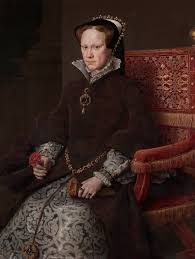
Eps 53: Biography Of Queen Mary The First Of England
— history
Queen Mary I of England, also known as Mary Tudor, was born in 1516 to King Henry VIII and Catherine of Aragon. She ascended the throne in 1553 after the death of her half-brother, Edward VI. Her reign was marked by her fervent attempt to restore Catholicism in England, reversing the Protestant reforms initiated by her father and her half-brother. This caused her to earn the moniker "Bloody Mary" due to the Marian Persecutions, where she ordered the execution of numerous Protestant leaders. Her marriage to Philip II of Spain was unpopular and failed to produce an heir, which further destabilized her rule. Despite her efforts, Mary's reign ended with her death in 1558, leading to the succession of her Protestant half-sister, Elizabeth I. Mary's legacy remains contentious, characterized by her religious zeal and attempts to revert England to Catholicism.
| Seed data: | Link 1 |
|---|---|
| Host image: | StyleGAN neural net |
| Content creation: | GPT-3.5, |
Host

Sheila Griffin
Podcast Content
Mary's reign was marked by her fervent attempt to restore Roman Catholicism after her father’s Protestant reforms. She earned the moniker "Bloody Mary" because of the Marian Persecutions, where hundreds of Protestants were executed for heresy in her quest to return England to the Catholic fold. Her marriage to Philip II of Spain, an ardent Catholic, aimed to strengthen her religious agenda but was met with resistance and failed to produce an heir, which many saw as a personal and political tragedy for Mary.
Despite the brutal suppression of Protestantism, Mary’s reign was also notable for several reforms and domestic policies, including a reorganization of the English navy and attempts to reform economic policies to stabilize the country. However, her efforts were often overshadowed by the ongoing religious strife and her mother's legacy being undermined by her father’s actions. Her relentless religious persecutions created a legacy of fear and division, which ultimately undermined her efforts to stabilize her realm.
Mary's health deteriorated under the constant stress of ruling a divided nation, and she passed away on November 17, 1558, at the age of 42, without leaving an heir. Her death paved the way for her half-sister Elizabeth I to ascend the throne, who reversed Mary's Catholic restoration in favor of Protestantism, leading to the Elizabethan era. Mary’s life and reign remain subjects of intense historical scrutiny and debate, embodying the complex interplay of power, religion, and gender in Tudor England. Her determination, faith, and tragic failures paint a portrait of a queen who fought against personal and political tides in a realm fraught with tumult and transformation.