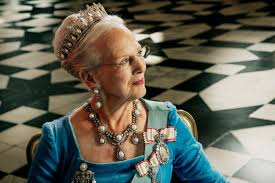
Eps 137: Biography Of Queen Margrethe The Second Of Denmark
— History
Queen Margrethe II of Denmark was born on April 16, 1940. She ascended the throne on January 14, 1972, following the death of her father, King Frederick IX. Known for her linguistic skills, she speaks multiple languages including Danish, French, English, and German. Queen Margrethe is well-regarded for her artistic talents, particularly in painting and illustrating, and has contributed to various artistic projects under pseudonyms. Advocating cultural and historical preservation, she has played a significant role in Denmark's participation in international cultural exchanges. Her reign has been characterized by modernization and adaptability, and she is deeply involved in both state and charitable activities.
| Seed data: | Link 1 |
|---|---|
| Host image: | StyleGAN neural net |
| Content creation: | GPT-3.5, |
Host

Lily Woods
Podcast Content
Margrethe II’s early life was marked by a rigorous education. She attended schools in Denmark, the United Kingdom, and France, culminating in studies of archaeology at Girton College, Cambridge, political science at Aarhus University, and further studies in philosophy at the Sorbonne in Paris. This diverse educational background has greatly informed her reign, infusing it with a cosmopolitan and scholarly perspective.
Fluent in several languages, including Danish, French, English, German, and Swedish, Queen Margrethe II's communication skills have enhanced her connection with global leaders and her own people. Her marriage to French diplomat Henri de Laborde de Monpezat in 1967 also underscores her international orientation. The union brought two sons, Crown Prince Frederik and Prince Joachim, into the royal fold, providing stability and continuity for the Danish monarchy.
Beyond her regal duties, Queen Margrethe II is noted for her artistic talents. She is a skilled painter and illustrator, often working under the pseudonym Ingahild Grathmer. Her work has been featured in numerous exhibitions and has graced the pages of popular literary work, most notably her illustrations for the Danish edition of J.R.R. Tolkien’s "The Lord of the Rings." These pursuits highlight her deepened cultural contribution to Danish society.
Moreover, Queen Margrethe II has been a vigorous patron of the arts and sciences, evidenced by her enthusiastic support for institutions ranging from museums to research organizations. Her philanthropic endeavors extend to humanitarian activities, focusing on social and environmental issues. This advocacy aligns with her broader mission to bridge traditional monarchy with contemporary issues and values.
In her role as a constitutional monarch, Margrethe II has remained a stabilizing figure during times of political change, embodying the ceremonial and unifying aspects of the monarchy without involving herself in the partisan fray. Her measured approach has garnered deep respect and affection from her subjects, cementing her legacy as an enduring symbol of Danish identity and heritage.
As Denmark continues to evolve, Queen Margrethe II remains a steadfast and dynamic figure, one whose reign bridges the historical and the modern, and whose life story is a testament to the adaptability and enduring relevance of monarchy in the contemporary world.