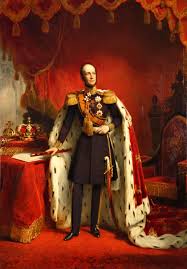
Eps 29: Biography Of King William The Second Of The Netherlands
— History
King William II of the Netherlands, born in 1792, was a significant figure in Dutch history. He ascended to the throne in 1840, following the abdication of his father, King William I. William II is known for his military background, having served in the British army and fought in the Battle of Waterloo. His reign was marked by considerable political and social upheaval, culminating in the Revolutions of 1848. Faced with widespread unrest and demands for constitutional reform, William II made a surprising decision to support the formation of a new, more liberal constitution, effectively transforming the Netherlands into a constitutional monarchy. This move was pivotal in shaping modern Dutch democracy. William II passed away in 1849, leaving a legacy of progressive governance and significant transition in Dutch political history.
| Seed data: | Link 1 |
|---|---|
| Host image: | StyleGAN neural net |
| Content creation: | GPT-3.5, |
Host

Willard Wilson
Podcast Content
In the 1840s, Europe was a powder keg of revolutionary sentiment, and the Netherlands was no exception. The growing demands for democratic reforms forced King William II to shift from his initial conservative stance. In 1848, with Europe on the brink of widespread revolution, he famously declared that he had "turned from very conservative to very liberal in one night," and he commissioned Johan Rudolph Thorbecke to draft a new Dutch constitution. This constitution marked a significant transformation, laying the groundwork for a parliamentary democracy by curtailing the powers of the monarchy and increasing those of the elected parliament.
William II's personal life was equally fascinating and fraught with complexities. He married Anna Pavlovna of Russia, with whom he had five children. However, his private life was marred by scandal and rumors, including whispers of his bisexuality and financial troubles. Despite these personal challenges, his reign was pivotal in steering the Netherlands towards modernity. His ability to adapt to the rapidly changing political landscape helped stabilize the nation during a precarious era.
King William II passed away unexpectedly on March 17, 1849, leaving behind a legacy of significant constitutional reform and a more modern, liberal Netherlands. His son, William III, succeeded him, inheriting a kingdom that had undergone substantial political transformation. William II's reign, though brief, was marked by crucial changes that set the stage for the future of Dutch governance and solidified his place as a key figure in the nation's history.