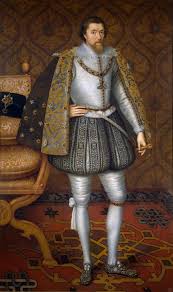
Eps 57: Biography Of King James The 6th Of Scotland And First Of England
— history
King James VI of Scotland, born in 1566, became James I of England in 1603, uniting the crowns of England and Scotland. He was the son of Mary, Queen of Scots, and became king at just 13 months old after his mother's forced abdication. James was well-educated, with a penchant for theology, literature, and political theory, which influenced his writings, including the King James Bible. His reign in Scotland was marked by efforts to pacify the nobility and Protestant tensions. In England, he pursued policies aiming at union and faced challenges like the Gunpowder Plot. His sponsorship of the arts and literature led to a cultural flourishing known as the Jacobean era.
| Seed data: | Link 1 |
|---|---|
| Host image: | StyleGAN neural net |
| Content creation: | GPT-3.5, |
Host

Vickie Pearson
Podcast Content
James's reign in England is particularly notable for his patronage of the arts and literature, including oversight of the King James Bible’s translation, an enduring religious and literary achievement. However, his tenure was also marked by challenges, such as financial difficulties and contentious relations with an increasingly assertive Parliament. The Gunpowder Plot of 1605, an attempt to blow up the House of Lords and assassinate the king, underscored the religious tensions of the time. Despite these challenges, James prided himself on being a peacemaker, pursuing policies of religious tolerance, though not always successfully, and attempting to mediate between warring European powers.
In his personal life, James was known for his intellectual pursuits and penned several works, including "Daemonologie," "Basilikon Doron," and "The True Law of Free Monarchies," which reflect his views on monarchical power and governance. Yet his relationships were complex; his close bonds with male favorites, such as the Duke of Buckingham, raised eyebrows and generated political friction. James's marriage to Anne of Denmark was considered politically advantageous, yielding three surviving children, one of whom, Charles I, would later inherit the throne, only to meet a tragic end in the English Civil War.
James I’s vision of a united Britain never materialized in his lifetime, but his efforts laid the groundwork for future unification. His reign, spanning over two countries and an era of significant cultural and political shifts, reflects the complexities of a ruler striving to harmonize diverse realms under a single crown. He passed away on March 27, 1625, leaving a mixed legacy of intellectual contributions, religious policies, and a precedent for his successors to follow.