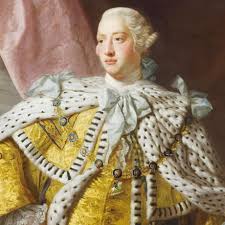
Eps 68: Biography Of King George The Third Of The United Kingdom
— history
King George III of the United Kingdom reigned from 1760 to 1820, one of the longest in British history. Born in 1738, he became king at 22, inheriting a rapidly expanding empire. His reign saw significant events like the American Revolution, during which the colonies gained independence. Known for his interest in agricultural innovation, hence the nickname "Farmer George," he supported advancements in farming techniques. Despite periods of severe mental illness, particularly in his later years, he was a dedicated and conscientious ruler. The Regency Act of 1811 saw his son, the future George IV, take over duties as Prince Regent due to the king's declining health. George III had 15 children with his wife, Queen Charlotte, and passed away in 1820, leaving a complex legacy marked by both expansion and conflict.
| Seed data: | Link 1 |
|---|---|
| Host image: | StyleGAN neural net |
| Content creation: | GPT-3.5, |
Host

Theresa Barnes
Podcast Content
However, George III is perhaps most famously associated with the American Revolutionary War. His government's policies and taxes on the American colonies led to growing discontent, eventually giving rise to the Declaration of Independence in 1776 and the subsequent loss of the American colonies in 1783. Despite this, George III's reign continued with a focus on the Napoleonic Wars, which dominated the latter part of his rule. His relationship with Prime Ministers, most notably with William Pitt the Younger, was pivotal in navigating these conflicts.
One of the more personal and tragic aspects of George III's life was his struggle with mental illness, believed today to have been caused by a condition such as porphyria. His bouts of madness, which became increasingly frequent from the 1780s onwards, often incapacitated him and eventually led to a regency being established in 1811, with his son, the future George IV, assuming the role of Prince Regent. Despite his health troubles, George III was known for his dedication to family life and his love of farming, earning him the nickname "Farmer George."
King George III's legacy is complex. He was a monarch who saw the British Empire through both significant triumphs and notable losses. His reign encapsulates a crucial period of change and development in British history, making him one of the most intriguing and multifaceted figures on the British throne. His life and reign offer a compelling study of the interplay between personal and political struggles, and the impact of leadership on a nation at a pivotal time in its development.