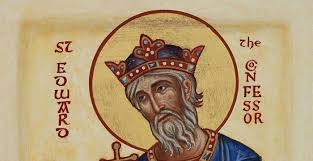
Eps 17: Biography Of King Edward The Confessor Of England
— history
King Edward the Confessor, born around 1003, was the son of King Æthelred the Unready and Emma of Normandy. Edward spent his early years in exile in Normandy due to Danish invasions in England. He returned to England in 1041 and ascended to the throne in 1042 after the death of his half-brother, King Harthacnut. Edward is renowned for his pious nature and his efforts to maintain peace during his reign. He had a stable and prosperous rule but faced significant challenges from powerful nobles, particularly the Godwin family. Edward married Edith of Wessex, daughter of Earl Godwin, but the marriage produced no heirs, leading to an uncertain succession. One of Edward’s significant achievements was the construction of Westminster Abbey, which began in 1045. Known for his devout Christianity, Edward was canonized in 1161, and his feast day is celebrated on October 13. His death in January 1066 led to a succession crisis that ultimately resulted in the Norman Conquest of England by William the Conqueror.
| Seed data: | Link 1 |
|---|---|
| Host image: | StyleGAN neural net |
| Content creation: | GPT-3.5, |
Host

Sean Brown
Podcast Content
Upon his return to England and subsequent ascension to the throne, Edward's reign was marked by his efforts to unify a kingdom fragmented by Viking invasions and internal strife. One of his most notable achievements was the construction of Westminster Abbey, a symbol of his piety and his commitment to monasticism. Edward's relationship with the nobility, including powerful figures like Earl Godwin of Wessex, shaped much of his policy and governance. Although he was credited with restoring some semblance of peace and order, his lack of an heir created a succession crisis upon his death.
Edward's canonization as a saint in 1161 by Pope Alexander III further cemented his legacy. Known for his deep religious devotion, he was later revered as a model of Christian kingship. His death marked the end of the Anglo-Saxon period, shortly preceding the Norman Conquest of 1066. Edward the Confessor's life and reign remain pivotal in understanding the historical and cultural transformations of medieval England.