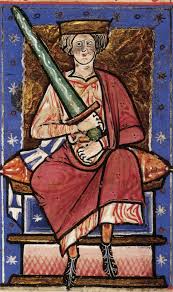
Eps 11: Biography Of King Aethelred The Unready Of England
— history
King Aethelred, known as "The Unready," ruled England from 978 to 1016 during a period marked by Viking invasions. His nickname, derived from "unraed," meaning ill-advised, reflects his struggles with governance and decision-making. Ascending to the throne after the murder of his half-brother, Edward the Martyr, Aethelred faced significant challenges, including continuous Viking raids. To deal with these threats, he resorted to paying substantial tributes, known as Danegeld, rather than military resistance, which drained the kingdom’s resources. His reign was further complicated by internal divisions and a lack of strong allies. Towards the end of his rule, Aethelred fled to Normandy when King Sweyn Forkbeard of Denmark invaded England. He briefly reclaimed the throne after Sweyn's death in 1014 but died in 1016, leading to a period of Danish control over England.
| Seed data: | Link 1 |
|---|---|
| Host image: | StyleGAN neural net |
| Content creation: | GPT-3.5, |
Host

Katherine Edwards
Podcast Content
Despite efforts to fortify the kingdom, his reign saw a deteriorating political landscape exacerbated by internal dissent and shifting allegiances among his nobles. In 1002, Æthelred ordered the St. Brice's Day Massacre, aiming to purge Danish settlers from his realm, a decision that precipitated even fiercer Viking retaliation. The situation became untenable in 1013 when Sweyn Forkbeard of Denmark invaded and briefly claimed the English throne, forcing Æthelred to flee to Normandy. Although he returned in 1014 after Sweyn’s death, Æthelred's subsequent rule was plagued by continued conflict until his own death in 1016, whereupon his son, Edmund Ironside, valiantly but briefly upheld the English resistance against the Danes.
Æthelred's reign, often overshadowed by his epithet and the calamitous events, nonetheless laid crucial groundwork for the eventual Norman Conquest. By navigating these tumultuous times, albeit with mixed success, Æthelred inadvertently set the stage for a redefined English statehood in the medieval period. His legacy, complex and often harshly judged, reveals the immense challenges of kingship during one of England's most perilous eras.