Eps 1: Battle of Hastings
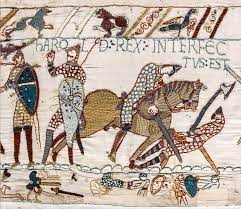
The Battle of Hastings took place in 1066 between William, Duke of Normandy and Harold II of England. The battle resulted from a succession crisis caused by the death of King Edward the Confessor. Harold Godwinson was crowned king, but Harald Hardrada of Norway and William also claimed the throne. Harold defeated Harald Hardrada, but William took advantage of this and invaded England. The two armies met in Hastings, with William's army composed of archers, infantry, and knights on horseback and Harold's army consisting mostly of infantry. The battle raged on for hours, but Harold was killed, and his army faltered, allowing William's army to break through the shield wall and eventually rout them. William was then crowned king of England, bringing about significant changes in English history, including a new Norman aristocracy, language, and laws.
| Seed data: | Link 1 |
|---|---|
| Host image: | StyleGAN neural net |
| Content creation: | GPT-3.5, |
Host

Byron Hopkins
Podcast Content
There are several factors that led up to the battle. Firstly, the death of King Edward the Confessor, who had no children, left a power vacuum in England. This led to a succession crisis, with several claimants vying for the throne. There were three main contenders: Harold Godwinson, the Earl of Wessex, who was crowned king after his brother Tostig was expelled from England by the Witenagemot; Harald Hardrada, the King of Norway, who also claimed the throne through his kinship to King Cnut; and William, Duke of Normandy, who claimed that King Edward had promised him the throne.
Ultimately, Harold Godwinson was crowned king, but the other claimants did not accept this and sought to invade England. Harald Hardrada sailed his army to England and landed in Yorkshire, where he defeated the English forces at the Battle of Fulford. However, Harold Godwinson marched his army northward and defeated Harald Hardrada and his army at the Battle of Stamford Bridge, killing both Harald and Tostig.
While Harold Godwinson was busy up north, William the Conqueror took advantage of this and invaded England from the south. William had gathered a large army of knights, archers, and infantry, and they landed in Pevensey, Sussex, on September 28th, 1066. Harold was forced to march his exhausted army from Stamford Bridge to London and then southward to Hastings, where he met William's army.
On October 14th, 1066, the two armies faced each other on a hill overlooking the town of Hastings. William's army was composed of archers, infantry, and knights on horseback. Harold's army consisted mostly of infantry, with a few knights and some archers. The battle began with an archery barrage by William's army, which Harold's army managed to withstand. Then, William's foot soldiers charged up the hill, but they were met with fierce resistance from Harold's army and were unable to break through Harold's shield wall.
The battle raged on for several hours, with neither side gaining the upper hand. However, one pivotal moment in the battle was when Harold was killed, possibly by an arrow piercing his eye, and his army began to falter. William's army switched tactics and feigned retreat, leading Harold's men to follow them, breaking the shield wall. William then managed to break through the English lines and the English army was eventually routed. The battle ended with an estimated 7,000 to 8,000 casualties on each side.
After the battle, William was crowned king of England on Christmas Day of 1066, and the Norman Conquest of England began. William's rule marked a significant change in English history, as he brought with him a new Norman aristocracy, a new language (French), and new laws and customs. The Battle of Hastings is regarded as one of the most important battles in English history, as it brought about a significant change in the country's political and cultural landscape.