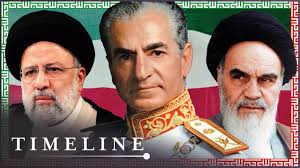
Eps 2: 1979 Iranian Revolution Explained Full Documentary
The 1979 Iranian Revolution was a major upheaval that led to the overthrow of the Pahlavi dynasty and the establishment of an Islamic Republic under Ayatollah Khomeini. Discontent with the Shah's regime, which was marked by autocratic rule, widespread corruption, and a perceived loss of cultural identity due to Westernization, sparked widespread protests. Economic struggles and political repression further fueled the unrest. The resistance was diverse, including religious clerics, leftists, and nationalists. The Shah fled Iran in January 1979, and Khomeini returned from exile to lead the new Islamic state, fundamentally transforming Iran's political, social, and cultural landscape.
| Seed data: | Link 1 |
|---|---|
| Host image: | StyleGAN neural net |
| Content creation: | GPT-3.5, |
Host

Arthur Taylor
Podcast Content
Public discontent was further fueled by the Shah's extravagant lifestyle and the perceived corruption within his regime. The catalyst for the revolution came in January 1978, when a derogatory article about Khomeini was published in a state-run newspaper. The article led to mass demonstrations and civil unrest, which were met with violent crackdowns by the Shah's security forces. Instead of quelling the dissent, these actions intensified the protests, uniting diverse groups ranging from secular leftists to conservative clerics against a common enemy. Over the course of a year, the protests grew in size and frequency, culminating in the Shah fleeing the country in January 1979.
Following the Shah's departure, Khomeini returned from exile to a hero's welcome and quickly consolidated power. In a national referendum held in March 1979, an overwhelming majority of Iranians voted to establish an Islamic Republic. The new regime embarked on a radical restructuring of the state, implementing Islamic laws and purging officials associated with the Shah's regime. The revolution was not without its internal power struggles, as various factions vied for dominance within the new political order. However, Khomeini's charisma and the revolutionary momentum helped solidify his vision of an Islamic state.
The international ramifications of the revolution were profound. Iran, previously a key ally of the United States in the region, became staunchly anti-American. This shift was dramatically symbolized by the seizure of the U.S. Embassy in Tehran and the subsequent 444-day hostage crisis. The Iranian Revolution also inspired Islamist movements across the Muslim world, demonstrating that an Islamic government could be established through grassroots mobilization and popular support. The revolution fundamentally altered the geopolitical dynamics of the Middle East, leading to a realignment of alliances and the onset of a protracted and contentious relationship between Iran and many Western nations.
In summary, the 1979 Iranian Revolution was a complex and multifaceted event driven by deep-seated socio-political discontent and led by a coalition of diverse groups unified in their opposition to the Shah. Its successful overthrow of a monarchical regime and the establishment of an Islamic Republic had significant domestic and international consequences, reshaping regional and global politics in ways that continue to resonate to this day.